Architecture
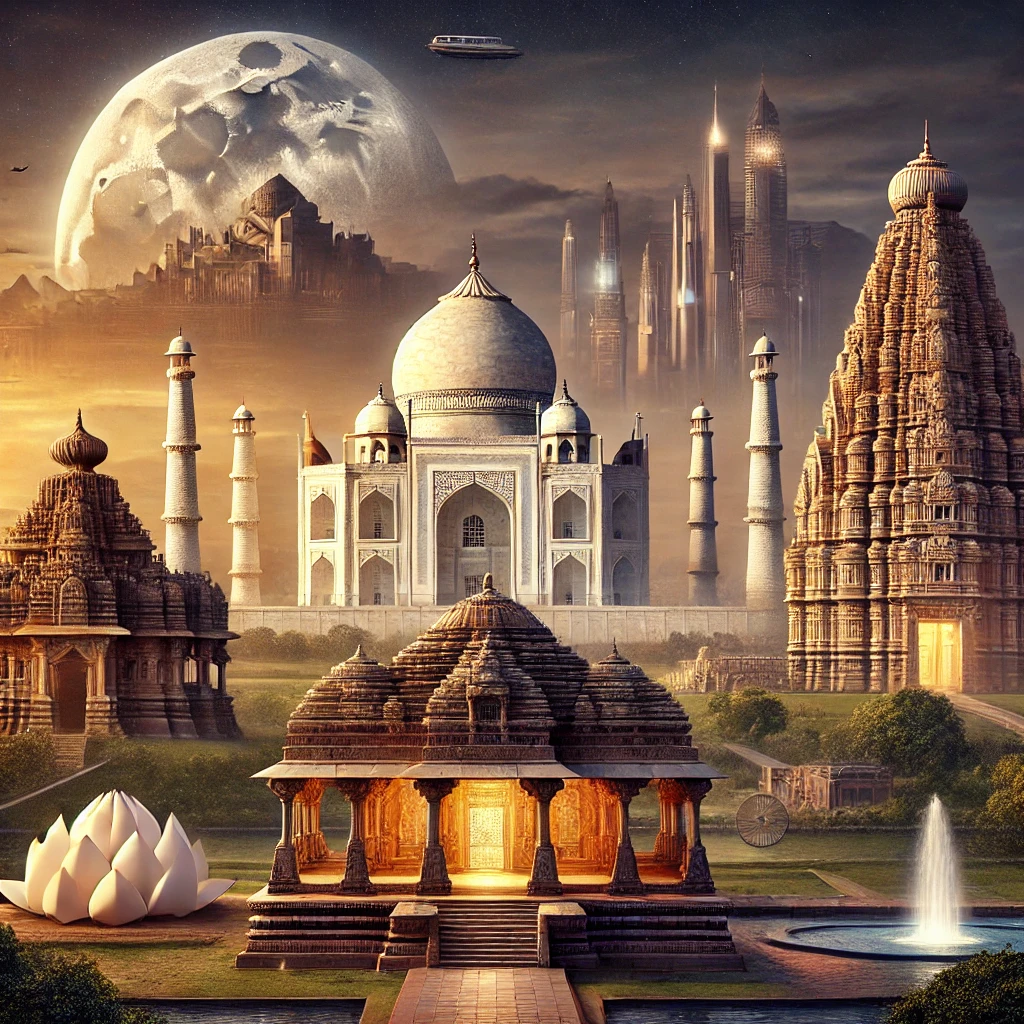
Every era left its monuments — explore the architectural record.
Explore the rich tapestry of Indian history from ancient civilizations to modern times, spanning over 5,000 years of cultural evolution.
One of the world's oldest urban civilizations that flourished in the northwestern regions of South Asia from 3300 BCE to 1300 BCE.
The formative period of Indian philosophy and religions when the Vedas were composed, laying the foundation for Hinduism.
One of the largest empires of the Indian subcontinent, founded by Chandragupta Maurya and expanded by Emperor Ashoka.
Known as the Golden Age of India, marked by extensive achievements in science, technology, engineering, art, and literature.
A Tamil dynasty that ruled southern India, known for their naval power, art, and extensive overseas trade networks.
Five dynasties that ruled from Delhi, introducing Islamic architecture, culture, and political systems to the subcontinent.
A South Indian empire that fostered a golden age of Hindu art, culture, and prosperity during Muslim rule in the north.
A dynasty that ruled most of the Indian subcontinent, known for its cultural blend of Persian, Islamic, and Indian styles.
A Hindu state founded by Shivaji that rose to prominence by challenging and eventually overthrowing Mughal dominance.
The period of British colonial rule over the Indian subcontinent, which brought significant political and social changes.
The nationwide struggle for liberation from British rule, led by figures like Mahatma Gandhi and Subhas Chandra Bose.
The development of modern India after gaining independence, focusing on democracy, development, and international relations.
India's history is a testament to the resilience, innovation, and cultural richness of its people. From the advanced urban planning of the Indus Valley Civilization to the scientific achievements of the Gupta Empire, India has been at the forefront of human civilization for millennia.
The subcontinent has witnessed the rise and fall of numerous empires, each contributing to its diverse cultural tapestry. The Maurya and Gupta empires established sophisticated administrative systems, while the Mughals introduced a blend of Persian, Central Asian, and Indian cultural elements.
The colonial period, though marked by exploitation, also brought about modernization in various sectors. The struggle for independence united the nation and gave rise to leaders whose principles continue to inspire the world. Post-independence, India has emerged as the world's largest democracy, navigating the challenges of development while preserving its rich historical heritage.
Indian history runs in an unbroken thread from the Indus Valley Civilization (3300–1300 BCE) through the Vedic age, Mahajanapadas, the great empires, medieval dynasties, Mughal era and British colonial period to independence in 1947.
The Indus Valley sites of Mohenjo-daro and Harappa show urban planning, drainage and trade networks rivalling contemporary Egypt and Mesopotamia. The Vedic period laid the philosophical and ritual foundations of Hinduism. The Mauryan Empire under Ashoka spread Buddhism across Asia.
The Gupta age (4th–6th c. CE) is called India's "Golden Age" — the era of Aryabhata, Kalidasa and the decimal system. Medieval India saw the rise of Cholas, Vijayanagara and Mughals; the modern era is defined by colonial rule and an extraordinary independence movement led by Gandhi, Nehru, Subhas Chandra Bose and many others.
Civilisation begins
~3300 BCE
Mauryan Empire
321–185 BCE
Gupta Golden Age
320–550 CE
Mughal Empire
1526–1857
Independence
15 August 1947