Festivals
Traditional outfits and what people wear when.
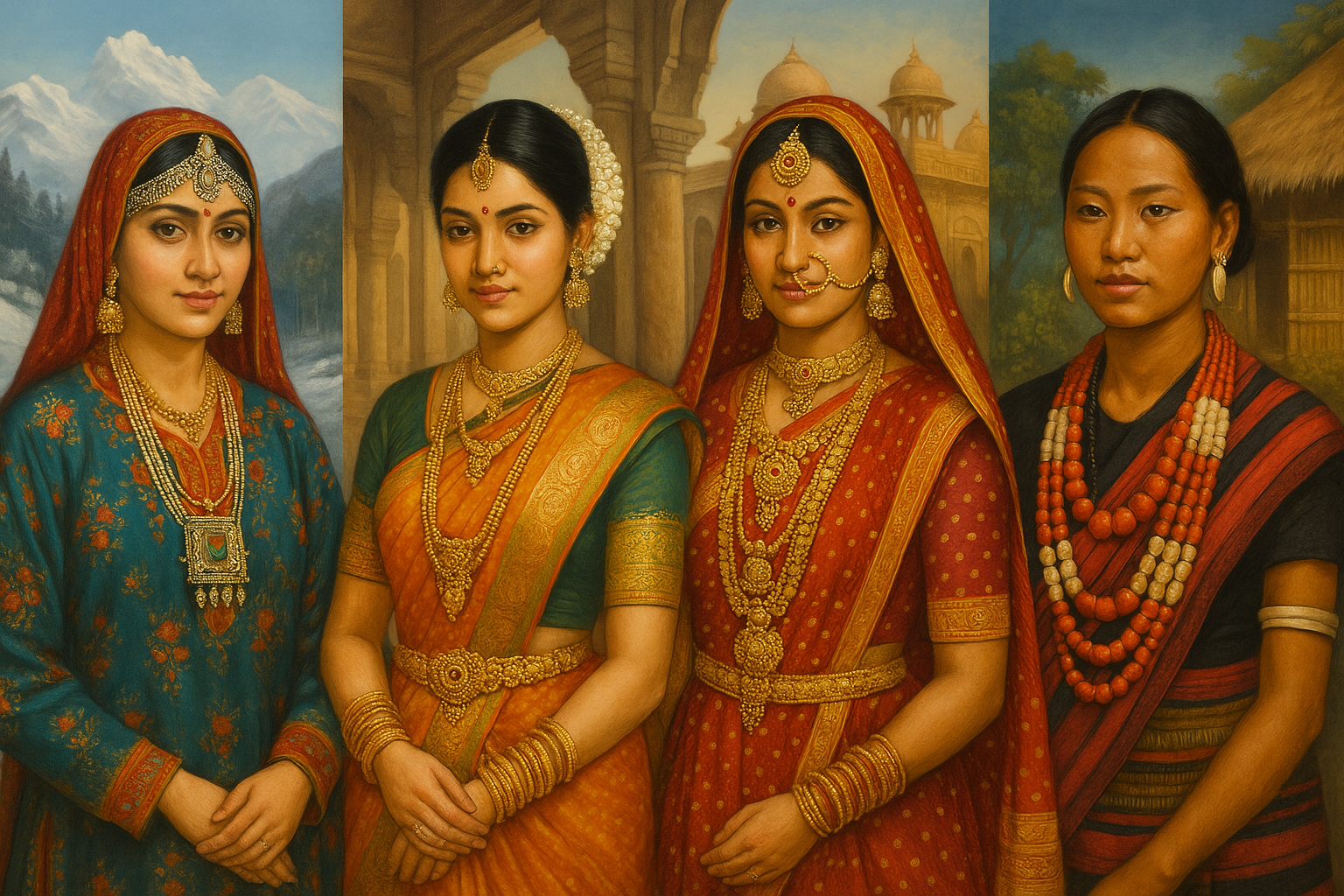
Explore the rich tapestry of Indian traditional attire and ornaments that reflect the country's diverse cultural heritage.
Indian traditional clothing and jewelry are not merely garments and ornaments but expressions of cultural identity, social status, and artistic heritage. Each region of India has developed distinctive styles, techniques, and motifs that reflect local traditions, climate, and historical influences.
From the intricate embroidery of Kashmir to the vibrant silk sarees of the South, from the tribal jewelry of the Northeast to the royal ornaments of Rajasthan, India's textile and jewelry traditions showcase remarkable craftsmanship and aesthetic sensibility that have evolved over thousands of years.
A traditional garment worn by women across India, consisting of a drape varying from 5 to 9 yards in length that is wrapped around the waist and draped over the shoulder.
A traditional ensemble worn by women, consisting of a long skirt (lehenga), a blouse (choli), and a dupatta (scarf).
A traditional men's attire consisting of a dhoti (a rectangular piece of cloth wrapped around the waist and legs) and a kurta (a loose shirt).
A long coat-like garment worn by men for formal occasions and weddings, typically paired with churidar pants.
An ancient form of Indian gemstone jewelry involving a gem set with gold foil between the stones and its mount.
Traditional jewelry from South India, originally created for adorning temple deities and later adopted for dance performances and weddings.
A traditional embroidery technique from Punjab, characterized by colorful thread work on shawls, dupattas, and other garments.
A tie-dye textile decorated by plucking the cloth with the fingernails into many tiny bindings that form a figurative design.
Luxurious silk sarees from Tamil Nadu known for their durability, vibrant colors, and intricate zari work depicting traditional motifs.
The traditional Assamese dress worn by women, consisting of two main pieces of cloth that are draped around the body.
A variety of sari made from silk and zari, characterized by borders of an oblique square design and a pallu with a peacock design.
A traditional form of uncut diamond jewelry that originated in India, featuring diamonds in their natural, uncut form.
Originating from Varanasi, these silk sarees are known for their gold and silver brocade or zari, intricate designs, and opulent embellishments.
From Tamil Nadu, these silk sarees are distinguished by their bright colors, heavy zari work, and contrasting borders.
Made from fine cashmere wool in Kashmir, these shawls are renowned for their softness, warmth, and intricate embroidery.
A dyeing technique used to pattern textiles, with notable traditions in Odisha, Telangana, and Gujarat, creating distinctive geometric patterns.
An ancient style of hand painting or block-printing on cotton or silk fabric with natural dyes, practiced in Andhra Pradesh.
Originating from Madhya Pradesh, these fine cotton or silk weaves are known for their sheer texture, light weight, and traditional motifs.
Indian clothing varies dramatically by region, climate, religion and occasion — from the unstitched elegance of the saree and dhoti to the regal sherwani and the everyday salwar-kameez.
The saree alone has 100+ regional draping styles — Nivi (Andhra), Bengali, Maharashtrian (nauvari), Gujarati, Coorgi, Manipuri and many more. Iconic weaves include Banarasi (Varanasi), Kanjeevaram (Tamil Nadu), Patola (Gujarat), Pochampally (Telangana) and Chanderi (Madhya Pradesh).
For men, dhoti, kurta-pajama and sherwani dominate formal wear; lungi and mundu are common in the south. Festival and bridal wear features intricate embroidery — zardozi, chikankari, kantha, phulkari and aari — often passed down across generations.
Saree drape styles
100+
GI-tagged weaves
60+
Cotton tradition
5,000+ years
Famous embroideries
Zardozi, Chikankari, Kantha